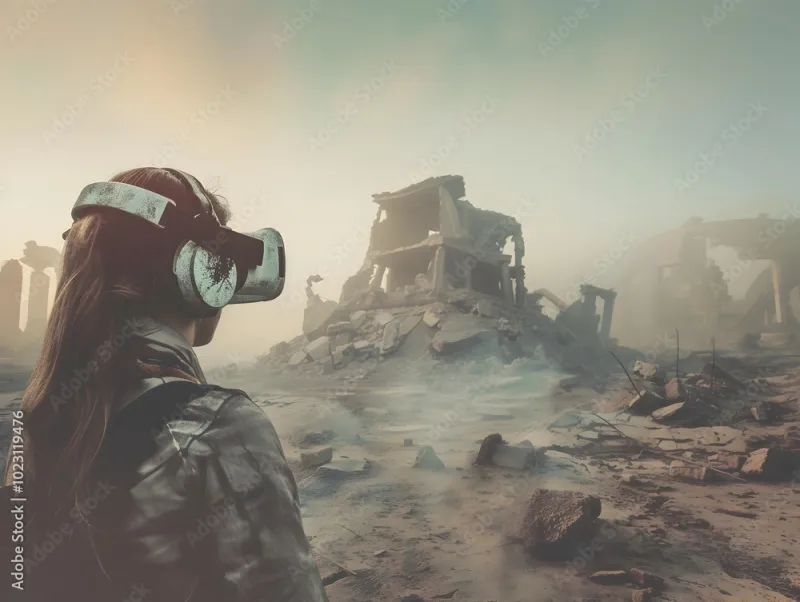
Lost in the Feed: Mapping TikTok's Algorithmic Wilderness
Photo: PattayaPatrol, CC BY-SA 4.0, via Wikimedia Commons
There's a specific feeling that hits around 2 a.m. when the For You Page stops making sense. The videos get quieter. The comment sections thin out. The hashtags attached to the content you're watching have numbers like 847 views, 12 likes, a single comment from an account with no profile picture. You've wandered somewhere the algorithm didn't exactly intend to send you — or maybe it did, and that's the part nobody's really talking about.
TikTok's recommendation engine is one of the most studied and least understood systems in digital culture right now. Everyone agrees it works. Fewer people have spent time asking what it looks like when it doesn't — or when "doesn't work" might actually be the whole point.
The Cartography of the Feed
Most conversations about TikTok's algorithm focus on its successes: the uncanny way it figures out you're interested in competitive dog grooming before you've consciously admitted it to yourself, the pipeline from casual viewer to obsessive niche community member. ByteDance's recommendation model is legitimately impressive at surface-level personalization.
But personalization has edges. And at those edges, things get weird.
Spend enough time deliberately nudging your watch behavior — pausing on obscure content, rewatching videos with minimal engagement, following accounts that haven't posted since 2021 — and you start surfacing what researchers and longtime users have started calling "dead zones." These are pockets of the platform where content exists in a kind of suspended state. Not deleted, not banned, just... sitting there. Accumulating nothing.
A 2023 study from the Mozilla Foundation found that TikTok's algorithm occasionally creates feedback loops around hyper-niche content that essentially trap users in increasingly specific micro-communities with no clear algorithmic pathway back to mainstream content. The researchers framed it as a flaw. But spend time in those spaces and the "flaw" framing starts to feel insufficient.
What Lives in the Gaps
The communities that exist in TikTok's algorithmic margins are genuinely fascinating in ways that mainstream FYP discourse completely ignores.
There are accounts dedicated to extremely localized phenomena — the specific vibe of a single highway interchange in rural Ohio at dusk, documented obsessively by someone who never breaks 200 views. There are micro-communities built around discontinued products, defunct restaurants, TV shows that aired twice in 2009. There's an entire stratum of content that feels less like entertainment and more like someone leaving evidence of their own existence in a place they suspect no one will find it.
This isn't the "weird side of TikTok" that gets written up in mainstream outlets — the intentionally absurdist humor, the performance of being strange. This is something quieter and more genuinely disorienting. Content that wasn't designed to be obscure but simply ended up that way, stranded by an algorithm that moved on.
Accident or Architecture?
Here's the question that actually matters: are these voids accidental, or is there something structurally intentional about their existence?
The cynical read is purely mechanical. TikTok's algorithm optimizes for engagement signals — watch time, shares, comments, replications. Content that doesn't generate those signals gets deprioritized, falls through the cracks, accumulates in the algorithmic basement. Dead zones aren't designed; they're just what happens when a sorting machine stops sorting something.
But there's a more interesting interpretation worth sitting with. Platforms like TikTok need perceived depth to maintain the illusion of infinite discovery. If every user eventually hit the same ceiling — the same 500 viral sounds, the same rotating cast of mega-creators — the mythology of the endless personalized feed collapses. The existence of these fringe zones, however accidentally produced, serves a psychological function. They make the platform feel genuinely vast.
When you stumble into a dead zone, you're not experiencing algorithmic failure. You're experiencing the platform's unconscious — the accumulated residue of everything it decided wasn't worth amplifying.
Trending Pages With No Audience
Among the stranger artifacts of TikTok's architecture are trending pages that appear to be trending for nobody. These are hashtag aggregation pages that the algorithm has technically categorized as "trending" based on some internal metric, but which contain a handful of posts, minimal engagement, and no visible community momentum.
Users who encounter these pages describe a specific uncanny quality — the UI looks exactly like a trending page should look, the formatting is identical to #fyp or #viral, but the content inside it feels abandoned. Like walking into a party that was apparently scheduled but where nobody showed up.
Some of these pages seem to be artifacts of algorithmic testing — categories the system briefly flagged and then deprioritized. Others appear to be genuine communities that briefly coalesced and then dispersed, leaving their hashtag infrastructure behind like a ghost town.
The Cultural Meaning of Algorithmic Wilderness
What does it mean for digital culture that one of the world's most powerful recommendation systems is quietly generating its own unexplored territories?
There's something genuinely interesting happening here that goes beyond platform critique. TikTok's dead zones are, in a weird way, the first truly algorithmic folk spaces — areas of the internet shaped not by human curation or community intention but by the emergent behavior of a machine learning system that nobody fully controls.
The content that ends up there isn't underground in the traditional sense. It's not countercultural or deliberately transgressive. It's just content the algorithm couldn't figure out what to do with, deposited in corners of the platform where the light doesn't quite reach.
For anyone paying attention to where digital culture is actually moving, those corners are worth exploring. Not because they're going to break into the mainstream — they're not — but because they represent something rare online right now: spaces that feel genuinely unmanaged. Places where the signal processing gave up and left something human behind.
The void, it turns out, has a For You Page. It just wasn't made for you.